Friday, 24 May 2013

Carrion to Torradillos

Day 16 (Thursday 23 May) 414 kilometres to Santiago. For dinner last night I walked to a nearby restaurant that advertised pizza. As I was about to walk through their front door at about 18:45 I heard my name being called. It was Paris Alain, with two Dutch ladies that I had met the night before in Boadilla, Rhea and Janni. They were dining on the restaurant's outdoor patio on the oher side of the narrow street. I joined them for exactly the kind of informal dinner that I had in mind. When Rhea asked where I was staying, I described my hotel (hostal) 200 metres down the street and said that my laundry was drying on the balcony. "I saw it" was her reply. "I know just where you're staying." So, my laundry is not just laundry, it's a flag. I'm in bed with the lights out by 21:00.

The next morning I wake in time for the hotel breakfast at 06:00. The price for OJ, coffee, and some baguette toast ( with real margarine and jam) was 3 Euro. Not a great value, but, from a quick map study the evening before, this morning's trek looks to be somewhat different - 17 kilometres of flat meseta before I encounter the first town. So, breakfast before departure it is. I take my time packing up afterwards and am finally away at 07:00; a late start for me. A week or so ago, Calgary Lise pointed out that I had some sunburn on the back of my neck; a disadvantage of T-shirts without collars. I have a solution readily at hand. The maple leaf headscarf that I wear when the weather looks like it might turn (it fits nicely under my rain jacket hood) also doubles as a turtleneck scarf. I still apply sunscreen, but the "necker" is another form of sunburn insurance.

Clearing the outskirts of Carrion, I notice once again that Spanish gas stations don't post their prices prominently. I detour over to one of the pumps to discover that low octane gasoline is 1.481 Euro per litre (about C$1.93). The day itself is the first one that doesn't seem to carry at least some risk of rain, and so it proves to be. The temperature is around 4 Celcius, but there is no wind, and the skies are clear. The forecast says that a high in the mid-teens is probable.

On the western edge of town I overtake a father and son from Pennsylvania. I'm not clear on the father's name yet, but I wish them a good morning. They ask where I stayed the night and I tell them about the hotel. Privacy, silence, my own bog and shower, and blessed darkness when I turn off the lights. I tell them that it was glorious and worth every cent of the 40 Euro that I paid. The son, Adam, who I believe is ex-US Army, says to his Dad: "That's it. We're going to one of those tonight". His father's response is to say words along the lines of: you wouldn't appreciate such luxury without first experiencing life in the albergues. He doesn't say "no" though.


The trail ahead is wide, hard-packed, and flat, so my pace is quick. I notice that some cut grass that is in the shade alongside the trail has frost on it. I overtake an older Italian gentleman who is walking slowly. He explains in reasonable English that one of his calf muscles is hurting him. Motioning an example I say: "Perhaps you need to stretch? "No" he says, "I need to be younger."

A few kilometres on, I unexpectedly come across a roadside entrepreneur who is selling BBQ sausage, coffee, and other delights. I buy just a banana and carry on (one of the more expensive bananas in this country at 80 Euro cents (about C$ 1.04)). When I finally raise the first town on the route, Caldadilla de la Cueza, I notice Rhea and Janni sitting out front of a bar/cafe, so I join them for coffee. I point out my new socks that I bought in Carrion de Los Condes yesterday afternoon - brown with orange trim (of course I'm wearing brown shorts to match). Rhea says that they didn't recognize me with my new socks, while Janni says that she likes the colour of the trim (the Dutch national colour - from the Royal House of Orange). The previous evening I had explained to Paris Alain that when Princess Christina was born in Ottawa during the Second World War, the Canadian Parliament of the day passed a law declaring that a particular room in the Civic Hospital was Netherlands territory, so that she would officially be Dutch from birth. Diane's father, Nick, fought through Holland during the war as an infantryman, so I feel a personal connection too.

Later, I overtake a nice Spanish gentleman from Barcelona. He explains that he completed close to 400 kilometres of the Camino last year and has now returned to finish the job. There are so many ways to do this. For some reason I'm reminded of an old black and white TV detective program from the early sixties. Remember? The one that always ended with: "There are 6 million stories in the Naked City; this has been one of them". Well, there are not that many stories on the Camino de Santiago, but there sure are a lot of different ways to travel the Camino Frances.

Closing in on the village where I plan to stay the night, I run across Tony from North Yorkshire (he lives about 45 minutes from Whitby, where Diane and I walked the moors and coastline for a week a few years back). He talks about his experiences so far in his distinctive Yorkshire accent: "soom days ...". About 45 minutes from Terradillos de Templarios, I unexpectedly overtake Caledon Angela, and we complete this leg together. The albergue is a modern low-rise that is somewhat distant from the village centre. The cost is only 7 Euro for a bed in a room that sleeps 10. As we are unpacking, Caledon Angela notices that an older German man and a much younger Dutch woman have checked in. She is non-plussed. Apparently these 2 were enjoying carnal knowledge of one another in a bunk bed close to hers last night. Yikes. I tell her that the man is older, so he probably won't be able to repeat the performance for a second night in a row.

As we check in, I notice several large rucksacks in the lobby area. All of them have the name of a bag transfer service attached to them: Jacotrans. These bags belong to people who are walking the Camino carrying only a day pack, while shipping there heavy ruck ahead to their reserved destination. This sight is quite common in the various albergues and hotels. To each his own.

There is no WiFi here, so I will look for an opportunity to post this blog along the way tomorrow.


Wednesday, 22 May 2013

Boadilla to Carrion

Day 15 (Wednesday 22 May) 440 kilometres to Santiago. When I checked into the albergue in Hontanas the day before last, I put my boots, as is customary, in a rack outside the door. The rack was protected from the rain. Although it didn't rain that night, the air was rather humid. When I put my boots on the following morning they were dry-ish, but not arid as I would like them to be. Later in the day I thought that I felt a couple of "hot spots" developing, so I stopped in a rest area and reapplied some lubricant to my feet. That worked well, as I still don't have any blisters. I wonder, however, whether that experience led to the onset of some athletes foot. In any case, I have it in one spot on my right foot, despite the application of foot powder each morning. I have everything that I need to treat it, but I suspect that I can only contain the damage rather than heal it as I'm putting in too many kilometres each day for my feet to really dry out. I'm considering a rest day, as I am 2 days ahead of my flexible schedule.

The rest area where I treated my feet yesterday had a local man selling coffee, cola, and some sad looking fruit from a small table on a cold morning. That must be a tough way to make ends meet, even in a country that has 25% unemployment.

I had a poor nights sleep in Boadilla last night because there was a world-class snorer in the next bed over (head to head). I slept for about 4 hours and woke at 01:30. At that point, this guy would have been rattling the paintings on the wall if there were any. Whoever trumpeted down the walls of Jerusalem could have saved themselves a lot of blowing if they had this character as a member of their army. In any case, I didn't get much sleep after that. I was up just before 06:00 and underway by half past, bound for Carrion de Los Condes, 26 kilometres away. The weather is cool, but, as it has been from the get go, with very light winds, at least at the start of my day. As I did the day before, I put on my MEC jogging mitts to keep my hands warm. For part of the first leg, I walk parallel to the Canal de Castilla.

Passing through the town of Fromista, I spot an ATM and top up on cash. A quick breakfast follows, chatting with Mike from Atlanta. I run into some more Americans on the outskirts of town, including the very polite Coby from Texas. Shortly thereafter I have a choice of routes: stay along the highway or deviate to the right alongside a small river. I choose the latter. The trail has been good so far, with no mud problems, and the river route looks more scenic. This occurrence also explains why there is no such thing as one true distance for the Camino de Santiago. I round mine to 800 kilometres. I should pass the half way point the day after tomorrow. So far, I have been the most pleased with the Meseta. It must be the Canadian prairie in me.


The weather holds for the balance of my day - mostly sunny but cool; ideal for walking. There are no public water fountains along this route, so, for only the second time since I started this adventure, I switch to my reserve bottle. I am pleased with my equipment choices, with the sole exception of a polyester pillow case that is too small. I'm keeping it in my rucksack just in case I need a cleaning cloth, but I would recommend a full size polyester or silk pillow case if you plan to stay in municipal albergues. The private ones, which I have come to favour, are quite diligent about providing clean bed linen.

At 12:30, six hours after I started out, I enter the town of Carrion de Los Condes (population 2,400). About an hour before a cyclist going the other way was passing out flyers for a small one-star hotel in town (Hostal la Corte). As I didn't sleep well the night before, I rationalize the expenditure of 40 Euro. They have a single room available and the luxury of it is exhilarating. My own room, with ensuite shower and toilet, cotton towels, and a small balcony for drying my dhobi wash. Gott in Himmel. I don't have to line up for a shower, so I head out to buy a bar of soap, and replace my lost T-shirt and socks. I'm successful on both counts. Life is good. I grab a quick lunch at a nearby cafe with 2 Australian ladies from Tasmania and then head back for a long hot shower and some treatment of my athletes foot problem. No pilgrims menu for me tonight; I'm going to satisfy my craving for a pizza.


Tuesday, 21 May 2013

Hontanas - Boadilla

Day 14 (Tuesday 21 May) 469 kilometres to Santiago. Two nights ago over dinner in Burgos, Newmarket Gerry said that he was having blister problems with his feet. When asked, he said that he lubricated his feet every morning with Vaseline. Strange. Did he get his socks wet at some point. A look, a grim nod - yes. While on the trail today, I thought about why he quit the Camino the morning following our dinner. Was it the blisters? Was it the frightening incident with the dogs? I don't know. The Camino turns into a motivating and spiritual event for some, and a disillusioning experience for others. I think that some of the factors are:

  1. Physical fitness;
  2. Medical problems, especially with the feet;
  3. Coping with being largely solitary while walking;
  4. Coping with the loss of privacy and personal space when staying in the hostels; and
  5. The repetitiveness of hostel life (showers, laundry, trying to stay warm in unheated rooms, dinner, and bed).

Of all the issues that I encounter, it's the foot problems that seem to be the most prevalent and that bother me the most. In many cases, walkers are in considerable pain only for want of useful information. Nonetheless, I have to be careful about what I say because many people take helpful advice as criticism of their ignorance. That seems strange to me because I am an inveterate borrower of good ideas. Notwithstanding, I will give my views if asked, but say nothing otherwise.

In Hontanas, last night, I was able to choose my bed and therefore selected a lower one that was furthest from the door that led to the toilets. I had a much better sleep as a result. I dined with some familiar faces, including Caledon Angela. The pilgrims' meal that I chose was excellent: ensalada mixto, chicken ragout, and ice cream. I was in bed by 21:00.

This morning, I rolled out at 05:45 and was underway in dim light by 06:25; destination Boadilla del Camino, 28 kilometres away. The temperature is about plus 2, but the winds are light and the sky is mostly clear. As I pull my walking sticks from a large canister next to the boot rack, I remind myself how fortunate I am that mine have natural cork handles. Not for the material itself, but for the colour. So many sticks have black handles that mine easily stand out, thereby making the morning search somewhat easier.

As I walk out of Hontanas, I encounter a somewhat ambiguous Camino sign that could be interpreted as straight ahead or angle right. I choose to carry straight on. After a few minutes I notice an absence of trail markers. I consult my guide book map and see that the path does divert to the right, to parallel a river. The map also shows, however, that the narrow paved road that I'm on also goes to my first waypoint, San Anton. Given that the river path may be muddy, I elect to carry straight on. A few minutes later I run across a tall, Spanish pilgrim who is walking toward me. I point ahead of me and ask as he passes: "St. Anton?" He gives me a voluble reply that I don't understand. The message seems clear though - he too has noticed the absence of markers and is backtracking to find the Camino. The difference between us is that I have a map and he, apparently, does not. Notwithstanding my somewhat reprehensible smugness, I have a feeling of quiet relief when the ruins of the convent at St. Anton heave into view about 40 minutes later and the Camino rejoins the road that I have been walking.

As I walk by my first waypoint, I hear a clock in a nearby tree. It isn't though, it's a real Cuckoo. The road carries straight on to the town of Castrojerez, where I have a light breakfast. I hope to find an ATM so that I can top up my cash supply, but, in the event, the Camino bypasses the main street and I don't spot a bank. Going through the town I walk for a few minutes with 2 ladies from Sheffield and we talk about walking holidays. They recommend the walk along (Roman Emperor) Hadrian's Wall, from the west coast of England to the east at Robin Hood's Bay (a place that Diane and I have been to on a walking holiday in Yorkshire). The Lake District is another favourite of theirs, as is the Northumberland coast. I file this away for future consideration.

On the far side of Castrojerez, the trail climbs at an angle to another elevated tableland. I stop partway up to reduce the amount of insulation that I'm wearing and to put on some sunscreen. Just as I dig the tube out of the bag, the sun disappears behind an overcast layer of cloud. It looks like it might start to rain. I decide - not yet - and carry on as before. As Dad was fond of saying: "Life is probabilities". We'll see how we'll I have judged them today. The view from the top is awesome. There is a huge number of wind turbines visible all around the near horizon. I descend to an ancient stone bridge near the village of Itero de la Vega. As I cross it I leave the province of Burgos and enter that of Palencia.

Just before the village of Itero de la Vega, I encounter Paris Alain, a dinner companion from the night before. Our conversation goes back and forth between English and French as we walk toward our common destination for the night. We stop for coffee in Itero and I notice that a few scattered drops of rain have started up. I choose to don rain gear and cover my pack, but, in the event, that proves to be overkill. We overtake Lynea from White Rock (a southern suburb of Vancouver) and I chat with her for a while. She started off staying in albergues, but didn't care for it. She says: "I'm a pilgrim not a martyr." Now she shares a hotel room each night with a congenial German lady who shares her opinion of hostels. Each to his own Camino.

Alain and I raise the village of Boadilla del Camino at 13:15, six hours and fifty minutes after I departed Hontanas, and check in to a private albergue. The sleeping quarters are somewhat cramped, but it will do. I miss the privacy and comfort of my own home, but that is one of the benefits of walking this rustic trail. Good friend Lorna Unger e-mailed me to ask why I didn't stop for a day to rest up and explore. I had to think about that today. I believe that it's because the scenery of the open road appeals to me more than the towns and villages. As White Rock Lynea put it today: "it's like walking from one spectacular landscape painting to another". I'm also not particularly intrigued with the history of the various churches and other local highlights that I come across. History on a grander scale appeals to me (the Roman Empire in this region, for example), but there is no convenient way to explore that. I suppose that another factor is how remarkably disinclined I am to do any more walking once I've reached my destination for the day (although that's another reason to stop for a while if the area is intriguing) In any case, I'm pressing on and enjoying what I can see along the Camino itself. I'm holding up reasonably well; I'm treating some athletes' foot (which occurred despite the daily use of foot powder) and my heel pain, but I'm optimistic at this point that these issues can be handled.


Monday, 20 May 2013

Burgos to Hontanas

Day 13 (Monday 20 May) 501 kilometres to Santiago. Last night, for a disappointing dinner at a local restaurant, we were joined by Gerry from Newmarket. During his walk that day he had come across a German lady who had been attacked by 2 sheep dogs. It was at the same point in the trail where I had a picture taken of me earlier, with the sheep in the background. The incident was upsetting, as she had been bitten badly in one calf. She was, apparently, not using walking sticks and therefore had no weapon to hand to fend off the dogs. I have been imagining this sort of incident, as there are so many dogs off-leash, and wondering how I would handle it. I can only picture compressing the top of at least one walking stick so that it became the modern day equivalent of a Roman legionary's gladius (short sword), and then doing battle. That's the image; I hope that I don't have to face the reality. Thinking along these lines does get me wondering what Roman Legion or Legions actually occupied this area of Spain. I think it was the Ninth in Britain (Peter, didn't you study a novel in junior high school called The Eagle of the Ninth?)

True to my new vow, I recovered my laundry from a 4th floor drying rack and hung it on my flex-o-line between my bunk and another before retiring last night. Everything was at hand for an early re-pack of my ruck.

My bed was assigned to me in the municipal albergue (sometimes you get to choose), and it was, unfortunately, adjacent to the toilets - the worst possible place. I slept between about 22:30 and 02:00, and then very little after that, as there seemed to be a constant procession of people going to use the bogs. Each time one of the 2 doors was opened, a light came on automatically and it cast a glare across my bed. The net result is that I rolled out of bed at 05:20. I thought, as did several others, that the front door was unlocked at 06:00. Wrong - the schedule says 06:30. In any case, a hospitallero let's us loose at 06:20. I am one of the first out the door as I plan to walk 32 kilometres today. The weather looks much more promising; broken cloud, no rain, light winds, and the promise of some sunshine. The temperature is in the mid single digits, and forecast to rise to the low teens. I can see my breath as I walk.

Yesterday was a tougher day. In part because of the rainy weather (it grinds on you even when you think that you're handling it). The other factor is the sense that our small group of, mostly, Canadians is unravelling. It's inevitable, of course, with everyone being in different physical shape and walking at different paces. Some people are hobbled by injury, or changing their plans, or outright giving up the Camino altogether. It's not the same experience for everyone. Notwithstanding, even though I am sleep deprived, I am responsible for my feelings and I resolve to treat these events as the beginning of making new friendships rather the loss of some familiar faces. Of our group, it would appear that Caledon Angela, Newmarket Gerry, and me are the only ones who are up for a longer route length today.

I set off in the semi-darkness but Burgos is a large city and it takes me 45 minutes to clear its western outskirts. I don't raise the village of Tarjados on the near horizon until 2 hours later. I stop for desayunos (breakfast). Any mud that I encounter is semi-frozen, so not a problem. Past this village the Meseta begins. I imagine that it derives from the Spanish word for table (la mesa). In any case, Diane's best friends from Winnipeg would feel, topographically, right at home here. I do to, having spent 8 years of my life in southern Manitoba and Saskatchewan. Walking across these Spanish prairies lifts my spirits, even though I am a solitary walker today.

The trail is, for the most, hard and fast. Just before my destination, Hontanas, it turns to sticky mud again. This slows my pace, but I manage to reach the private albergue exactly 7 hours after I started out. They have a bed available. Later, as I'm cleaning my boots and hanging my dhobi laundry, Caledon Angela shows up. It's nice to see a familiar face. I ask about Newmarket Gerry, and she tells me that he woke this morning and decided to pack it in. He's had enough and is going home. I book only 2 seats at the 19:00 sitting in the attached restaurant.


Sunday, 19 May 2013

Ages to Burgos

Day 11 (Sunday 19 May) 527 kilometres to Santiago. My sister Susan and her husband David mentioned that their grandchildren thought that the total distance of my walk would be about the same as Ottawa to Hamilton. That motivated me to look that up; one on-line calculator says that driving distance is 523 kilometres. So, if that's true, my walking distance should be closer to Ottawa to Sault Ste Marie (793 kilometres). In any case, doing it in Northern Spain is more interesting, especially because I don't have to walk on highways very often.

Yesterday, as I was working on a new blog post, NY Chris, looking at the length of it, said that I ought to turn it into a novel. I said that I'd give it serious consideration if it weren't for the fact that eating is a hard habit to break. I'm also making sure that my blog is non-fiction, with the occasional embellishment for the sake of humour.

Last evening I enquired about the 19:00 pilgrims' sitting at the restaurant next door, only to be told that it was full. The next one would be at 21:00. The hospitallero at our albergue directed me to another restaurant down the street and indicated that I would have to make a reservation in person. After obtaining a head count of those that were interested, I jogged through a cold rain to book a table for 8. As I did so, a loud clap of thunder echoed through the village. This part of the world has interesting spring weather.

We arrived for our 19:00 booking to find a pleasantly set table in one corner of the small dining room, with a "reserva" sign in the middle. The menu was fixed: ensalada mixto, bread (pan), wine, and paella. That suited everybody. It turned out to be the best paella that I've ever had. To top off our evening, our server brought out one dessert cake with a candle on it so that we could sing Happy Birthday to NY Chris. He is leaving us tomorrow by bus for the American Consulate in Madrid, to try to arrange an extension to the standard European Union 90 day tourist "visa". He's been on the continent for some weeks and is worried that his official tourist allowance will run out before his travel plans do.

I do not sleep well last night and am out of bed at 06:15, and underway for Burgos (21 kilometres away) by 07:00. One of my father's favourite quotes was from Hamlet: This above all, to thine own self be true, and it follows, as the night the day, thou can'st not be false to any man. I intend to keep that wisdom in mind as I walk.

I check my rest area carefully before I leave, to ensure that I've left nothing behind, and even do my calf stretches outside before I set off. I'm in full rain gear. The overnight forecast temperature was 2 degrees, but it feels slightly warmer than that. A steady light rain is falling. Parts of the trail are quite muddy. On some sections, there is a grass verge to the right that is heavily used in order to avoid the worst of the mud. Other parts of the path are covered in sharp stones. I concentrate on each step as I make my way through, as the risk of a sprained ankle is evident. I've come to the conclusion that no matter what you do on the Camino, you have to do it carefully and deliberately. Even turning around to see if anyone is coming up from behind: stop, turn, look, turn, step off. I suppose that this is a variation of the adage that if it's worth doing, it's worth doing right, with an emphasis on avoiding putting a foot wrong and ruining the whole pilgrimage. At one point I stop for a water break and accidentally drop my water bottle top. There are sheep droppings on the trail, so I take out an alcohol swab and clean the top before putting it back on.

As is my custom, I start out without breakfast and look for a place to stop enroute. Today there are 2 villages that are off-trail, but I don't risk deviating because it's early on a Sunday morning and there will not likely be anything open. After more than 2 hours, I raise the village of Cardenuela. I stop for breakfast and, out of an abundance of caution, clean my water bottle with a purpose-built tablet from Camelback. I've heard several stories about people forgetting to pay for a breakfast or lunch meal, including one from Caledon Angela. I almost follow suit, but I only walk a few metres before I catch my error and return.

Leaving Cardenuela, the rain has eased, but not stopped. The previous evening a friend of Caledon Angela had recommended an alternative route into Burgos; along a river instead of the 2-lane highway. As I'm about to turn onto this trail, I encounter a Spanish couple coming the opposite way. As they pass, they say in English: "much mud". Although I'm uncomfortable with the passage of high speed traffic on the narrow road that I'm walking, I stay with it rather than risk another quagmire. I walk around Burgos airport and into the outlier town of Villafria. From here, I walk for 2 hours on hard pavement or sidewalk through the industrial outskirts of Burgos and into the centre of the city (population 170,000), looking for the municipal albergue. I find it at 12:30, five and one half hours after departing Ages. There is a line out the door,waiting to register. It takes me 45 minutes to reach the front desk. I consider going back out after I've checked in, to look for a new T-shirt and a pair of socks, but almost all the stores were closed on my walk through town (except for some bars, cafes, and bakeries), so I don't bother. Of course the rain stops just as I arrive at the albergue

As I head downstairs to do some laundry, a pleasant surprise. Calgary Lise and Dutch Yvonne are walking up to their dorms. They had to take a bus from the last town because of a thunderstorm that included hail. I do a tour of the massively ornate Burgos Cathedral before supper. Over the top. Supper follows at a local restaurant. Unfortunately it turns out to be the worst of the pilgrims' meals that we've had so far. That, combined with the weather and the fact that some people may be changing their plans (Victoria Ali for sure), has rendered this day a bit of a downer. Checking my map, I sense that I will have to do about 32 kilometres tomorrow on my own with no guarantee of a bed at the other end. Well, things will pick up. This is still an adventure like no other.


Saturday, 18 May 2013

Belorado to Ages

Day 11 (Saturday 18 May) 550 kilometres to Santiago. I have warm enough clothes for the trail, but perhaps not enough for a cold albergue. I lay in my bunk for a while yesterday just to warm up, although I still adhered to my policy of no napping. I went down to the kitchen to stand by the wood stove after that. The Korean contingent had cooked their own communal meal and were in the process of enjoying it. They may be making the effort to cook for economy reasons, but I suspect that the pleasure of eating familiar dishes is a large part of their motive. We dined last night in the on-site restaurant. The meal was good, but the fresh vegetables once again failed to appear. It's back to relying on ensaladas.

I woke this morning at 06:00 and was underway at 06:45, having been advised by Netherlands Herman and Joyce that the on-site 3 Euro breakfast wasn't worth it. The temperature felt like a degree or two above zero, but the wind was light and there was no rain from the mid-level broken clouds. About 4 kilometres out of Belorado I had another "oh no" moment. I leaned on my walking sticks as I realized that I had left a T-shirt and a pair of socks in the laundry room. They were not quite dry last night and I told myself that I'd pick them up in the morning. It's not the loss of the clothing, of course, it's the mild shame of being careless. I'll pick up some replacements tomorrow in Burgos (if there is the right store open on Sunday). In the interim, I'll have to work harder at my new, hard won policy: everything has to be under or beside my bed before I go to sleep, even if I have to put my damp laundry in a plastic bag. If not, I'll be adding to a reputation that I really don't want.

There was no coffee in the next village, Tosantos, so I pressed on to Villambistia. There was coffee available there, but the breakfast offerings were meagre. Another breakfast stop in Epinosa del Camino, 2 kilometres on, fixed that. The coffee in northern Spain is universally excellent (not like your experience in Prague, Mona). It puts those Bunn coffee makers that you see all over Ottawa to shame. The only drawback is that it's cheaper to buy a glass of vino tinto (1 Euro) than a cafe con leche (1.5 Euro). I actually saw one pilgrim drinking wine with her morning pastry. It reminded me of a flight safety course that I took years ago, wherein a flight surgeon explained that normal people take a drink to feel good and alcoholics take a drink to feel normal.

After the next village, Villafranca, the terrain starts to rise; there will be 400 metres of ascent today (peaking at 1,150 metres), to add to the 28 kilometre distance to my destination. I'm dressed in shorts, but have 3 layers on top as the temperature remains low and the wind begins to rise as I ascend. Getting close to the height of land, I chat with 2 girls from Slovenia. Our conversation is a fractured mix of English and German. My pathetic German contributes such eloquent statements as "keine schnee" (no snow). I had half expected to see some at the summit of this ridge line, but no. The wind comes up again though, to the point where I put on my toque for the first time. Yesterday I listened to the steady patter of rain drops on the hood of my jacket. Today the weather holds fine, but the previous day's rain has rendered some parts of the trail muddy. This slows my pace somewhat and, at least temporarily, adds to the weight of my boots. I think of Rex Harrison singing "the rain in Spain ...", and think "bollocks". The high ground gets it too. Though as I recall, My Fair Lady didn't have a preface saying that it was based on a true story.


My guide book recommends staying in St. Juan de Ortega, but there were better albergue choices in the next town, so we reserved a block of 8 beds in Ages the night before. Talking to many people who have done the Camino in the past, the almost universal opinion is that it's changing fast. There are now more people and therefore much more competition for beds. The "race" atmosphere is not what anyone wants, but being told that there are no beds available in mid-afternoon and being directed to the next town 5 or 10 kilometres on, when you've already walked 25, would not be a pleasant experience. Like it or not, it's happening. We surmise that there are at least 3 causal factors:

  1. The popularity of the John Brierley guide book, which tends to concentrate walkers in the same towns and villages;
  2. The Yuppie preference for more upscale albergues, which tends to overburden the ones that are here now; and
  3. The popularity of the movie The Way (which co-stars my friend Ron Huibers; notwithstanding what the credits say about who plays the Dutchman alongside Martin Sheen).

Our tactic for the near term is to have the hospitallero call ahead to the next private albergue that is highly, if subjectively, rated and reserve the required number of beds. This approach will not likely last for long, but it has worked well for us on 3 occasions so far.

As I approach the village of Ages, my heels are giving me some discomfort. I know exactly what the problem is: plantar's fasciitis. This is a tightening of the calf muscles that, in turn, causes the tendons or ligaments or whatever in the feet to tighten up. In my case, this condition manifests itself as heel pain (Bob and Eleanor, if you're reading this, forgive the medical imprecision of my explanation). In any case, all I have to do is some calf stretching exercises and I'll gradually get better. I have been remiss in this department, but resolve to do better.


The albergue that I check into is really good. I have a single, low rise bed for the first time. I didn't have lunch on the road, so I drop into the next-door restaurant for a bacon and egg sandwich and a glass of wine. I follow this with a shower in the best facilities that I have had yet. Some of the others start straggling in by mid-afternoon.


Friday, 17 May 2013

Santo Domingo to Belarado

Day 10 (Friday 17 May) 574 kilometres to Santiago de Compostela

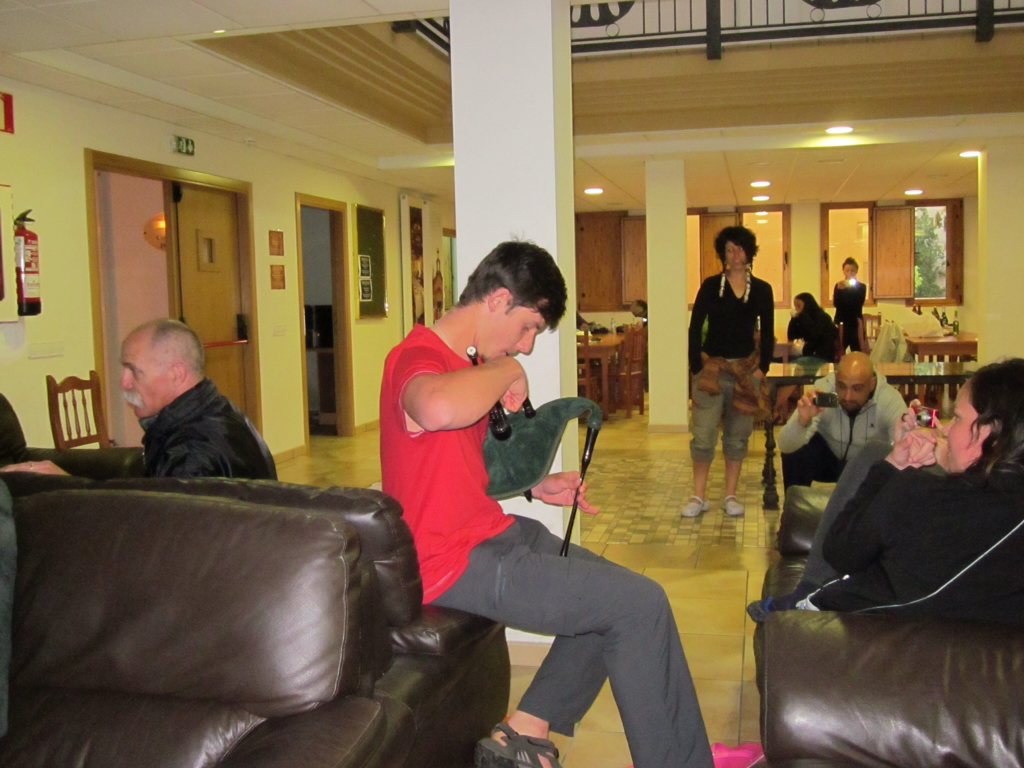
Last night several of us agreed to have a casual supper in the dining area of the albergue. New York Chris and I head out at 17:00 to do some grocery shopping at the local stores. Baguettes, cheese, sausage, tomatoes, cucumbers (yech), wine, and chocolate. We return towards 18:00 and claim a corner of the dining room with soft sofas. Gradually, the group drifts in and helps themselves. Partway through our meal a young Italian man takes out an instrument that looks like a small set of bagpipes and begins to play. I ask him the name of his instrument, but don't catch his response (Adrienne Quane, a world class bagpiper, will know what it is). I ask my companions whether they know the definition of a gentleman. A man who knows how to play the bagpipes but doesn't (the joke only applies to men Adrienne).

Part of our group this evening are the 2 ladies that I thought were of Jamaican origin when I first met them several days ago. In fact they were originally from South Africa, but have lived the last 10 years in St. John's. One or both are doctors. To my tone deaf ears, when you mix Afrikaans English with 10 years of exposure to Newfoundland, it comes out Jamaican. Sorry ladies; I'll look into getting my ears cleaned.

My RON in this "donativo" albergue (pay what you can afford) is very good. RON is Air Force for Remain Over Night; pronounced R_O_N, rather than sounding it like Huiber's first name. My companions tell me that some of theirs have not been so pleasant. Victoria Ali says that she spent one night dormed with several young South Koreans, who went out to party. One of the girls came back completely blotto. She vomited on the floor in the toilet area (which had to be cleaned up for her), and then spent the rest of the night retching into a bucket beside her bed. Ali didn't get much sleep.

I can't fail to notice in the middle of the night that some of the women are going to and from the toilet in underwear and a T-shirt. Yikes. I'm too shy for that. Before retiring for the night, I use one of the toilet stalls to change into Joe Boxer pyjama shorts. I like them, especially because they have 2 front pockets, where I keep my passport and my wallet. The risk of theft on the Camino appears to be very low, but it's not zero, so I take what seem to me to be reasonable precautions.

During our evening conversations, I reflect upon the Camino experience. We are all volunteers on this adventure and we extend trust and friendship to the others who are sharing it. "Paying it forward" is the norm. All of us know that we could need both the moral and physical support of others to get through this sometimes arduous experience. A few nights ago, multi-lingual German Annie told me that she had read a book that said, in essence, everyone will cry at least once on the Camino. I haven't felt anything even close to that, but it does give you fair warning that this unique adventure is more than just being physically fit enough to get it done. Lots of e-mails from family and friends help to buoy my mood each day.

The best illustration that I can offer of the Camino spirit is the rally around Calgary Lise that happened when she limped into Santo Domingo de la Calzada yesterday afternoon. She took a cab for the last few kilometres, because her "shin splints" were extremely painful and her blisters weren't far behind. She stopped at the local hospital and then went on to the albergue to consult with the on-site para-medic foot specialist (he has been looking after pilgrims here for 20 years). While he was treating her wounds, Sandra from Bathhurst, NB, held her hand; Toronto Angela (actually from Caledon; her new handle) got her a blanket; I went to the store to get her an apple; New York Chris, in the middle of dinner, went to the drugstore before it closed to get her some Ibuprofen (600 mg. tablets - 3 times more powerful than back home), and Yvonne (the Dutch policewoman) phoned ahead to reserve her a hotel room in the next closest town so that she could deal with her wounds in comfort and in private. Not only that, Yvonne also booked a room in the same hotel, so that Calgary Lise would not be alone. That's the Camino de Santiago.


Calgary Lise consulting with the Foot Doctor

In the morning, a Quebecoise in the lobby area tells me that it's raining. So, for the first time, I set off, at 06:45, in full rain gear and with my rucksack cover up. There is a low overcast and a light wind; the temperature is in the high single digits. I notice some people walking with long capes over their rucksacks and shoulders, some of them with a between-the-leg strap to keep them from billowing. In my view, those that are also wearing rain pants or gaiters (to keep the socks and the inside of the boots dry) will be fine. Those that are relying solely on a cape may be in for a not so pleasant experience. Here endeth the lesson.

The trail is mostly pavement or hard-packed earth, so there isn't the mud problem of yesterday. I trudge on through the rain and the low rolling hills until I see the village of Granon. By 08:15 I'm seated at a cafe having a "tortilla patatas" (Spanish omelette), a crust of baguette, and a coffee. I top up my water bottle at a "fuente" (fountain) on the western outskirts of the village. I'm carrying two 750 millilitre plastic (BPA-free) water bottles; one in a pouch on the waistbelt of my rucksack and one in reserve in a side pocket. The water from the municipal "fuentes" has been fine (unless labelled as non-potable) and I have only had to take out my reserve bottle once so far. 1.5 litres seems to be a perfectly adequate load. I'll have to see whether crossing the "meseta" in warmer weather changes that view, but I doubt it.

I arrive at a private hostel in Belorado (23 kilometres from my start point) at noon; 5 and 1/4 hours after starting out. The weather has been cold (the wind came up) and it rained most of the time. The hostel doesn't open until 12:30, so I put my pack at the back of the line along the wall and wait my turn to check in. Caledon Angela booked beds for 10 of us ahead of time, so we're in good shape. The honourary Canadians in the group this night are New York Chris, and Herman and Joyce (an anglicization) from the Netherlands. Just before I sit down to register, a shower of ice pellets forces many of those waiting outside to scurry into the lobby for cover.

So far I have been spending about 30 Euro per day. Five for breakfast, 5 for lunch, 10 for accommodation, and 10 for dinner. This amount goes up if I decide to use the "lavadora" (washing machine) and/or "secadora" (clothes dryer). That normally only happens if the weather is not sunny or there is a paucity of clothesline space. I've had no problem finding free WiFi (wee fee in France and Spain).

Tonight we have reserved space for all of us for dinner at 19:00, in the on-site restaurant. The hospitallero says that they grow much of the food in their back garden. The hope for fresh vegetables springs anew. I'll post this blog now and then fill in the rest of this day's activities when I find time tomorrow.